Trees

Measuring Schoolyard Heat One Step at a Time

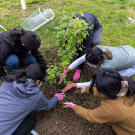
A team of researchers from University of California, Davis, spent the summer at elementary schools across the state measuring tree canopies and just how hot playgrounds, basketball courts, soccer fields and other outdoor spaces can get.

Tree canopies at California schools cover only about 4-6% of the average campus, meaning student breaks and outside activities are often under the glaring sun for the roughly 5.8 million K-12 public school students in California. 

How UC Davis Is Growing a Tree Canopy for Tomorrow’s Climate

The cooling shade of UC Davis’ mature, leafy trees impressed Nurjannah Wiryadimejo enough to help the now-graduating senior choose to become an Aggie.

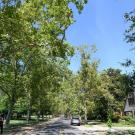
“When I first came to Davis, what struck me was how beautiful the cork oaks are. I’d never seen such beautiful tree-lined streets like the ones by the Memorial Union,” she said. 

“But now I’ve realized that a lot of the trees on campus aren’t well suited for the future climate, when there will be more heat and extreme weather events,” said the environmental science and management major. 

Becoming Arizona: Sacramento’s Urban Heat Island Divide

Beyond Beautification, Trees Are a Health and Climate Justice Solution

A tree sits in the middle of a big empty lot in South Sacramento. It is huge and leafy, its arms open wide, an arc of green swooping across a hot summer sky. Fenced off in this abandoned car lot, the tree is a bold sign of life in an otherwise barren expanse of dirt and busted concrete. It’s a wonder that it’s still here.

This old lot looms large for Victoria Vasquez. Her dad used to live a half mile from this spot.

The Genetics of Drought Tolerance in Bioenergy Poplar Trees

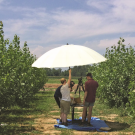
Bioenergy crops are central to climate mitigation strategies. This includes their use in BECCS (Bioenergy with Carbon Capture and Storage) and biomass supplied for heat, power, liquid fuels and in the future, biorefining to chemicals. It has been predicted that bioenergy will be the fastest developing renewable resource over coming decades, but at the same time, land use for bioenergy production can be controversial if it has negative impacts on land for food, or is detrimental to a wide array of ecosystem services.