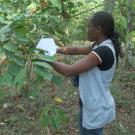
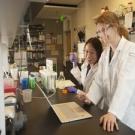
Borlaug LEAP Fellows work with UC Davis faculty in a program that is designed to improve food security in sub-Saharan Africa.
Jemima Adepehin and Chinyere Florence Anagbogu are Nigerian graduate students who recently completed work with UC Davis faculty through a fellowship program designed to improve food security in sub-Saharan Africa: the Borlaug Leadership Enhancement in Agriculture Program (Borlaug LEAP). Enriched by their experiences at UC Davis, both women are back home, making a real difference in the lives of others.
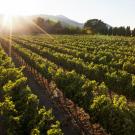
Local climate and environmental conditions leave a specific "fingerprint" on the composition of wine.
Regionally distinctive groups of bacteria and fungi, associated with local climate and environmental conditions, may leave a very specific “fingerprint” on a wine’s chemical composition, report University of California, Davis, researchers who collaborated on a new study with two Napa Valley wineries.
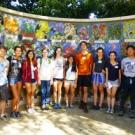
Congratulations to the 1,615 undergraduate students who will cross the stage at one of two CA&ES commencement ceremonies on Friday, June 10, in the ARC Pavilion. We are anticipating the participation of numerous faculty and 60 volunteer staff in this year’s ceremonies.
Our distinguished speakers this year include alumni Richard and Evelyne Rominger, who for decades have played prominent roles in the community and in statewide and national agriculture. Richard and Evelyne Rominger also have been named recipients of the 2016 UC Davis Medal, the premier campus accolade.
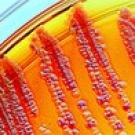
UC Davis startup, Astrona Biotech, aims for handheld pathogen detector
Marc Pollack, a Ph.D. student in the UC Davis Microbiology graduate group, and Jeremy Warren, a former postdoc in Plant Pathology, leave Davis at 5 a.m. every weekday morning to commute to IndieBio, a startup accelerator in a narrow alley just south of Market Street in the heart of San Francisco.
Kinsella Prize winner demonstrates improved way to process biomass
Amanda Hildebrand, who recently completed her Ph.D. in biological systems engineering, has been awarded the John E. Kinsella Memorial Prize for her outstanding doctoral dissertation on a novel, cost-savings approach to processing cellulosic biomass, a sustainable source of energy.
Results offer hope for tackling child malnutrition
The “forests” of microbes that naturally grow in babies’ guts are increasingly recognized as key players in childhood health and nutrition.
In two newly published studies, research teams led by Washington University, St. Louis, in collaboration with UC Davis scientists, demonstrate that gut microbes can contribute to or prevent impaired growth and that specific sugar compounds found in milk can help promote growth by nourishing gut microbes.