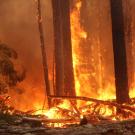
Satellite data from across California’s landscapes reveal an increase in nitrogen dioxide levels in remote forest areas, and wildfire and soil emissions are likely the reasons why, according to a paper from University of California, Davis, published today in the journal Environmental Research Letters.
As part of a historic partnership between the University of California and the state of California, UC today announced it is awarding over $80 million in climate action grants. The grants will spur implementation of solutions that directly address state climate priorities.
Four UC Davis projects are among the grantees. They include:
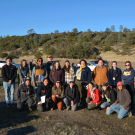
A team of UC Davis doctoral and undergraduate students have something to celebrate as the fall quarter comes to a close. UC Davis sent a team to the Region 6 (southwest) Collegiate Soil Judging Competition, where groups are scored on their ability to describe and classify soils and landscapes.
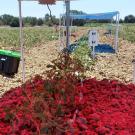
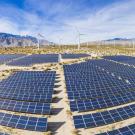
People are increasingly trying to grow both food and clean energy on the same land to help meet the challenges of climate change, drought and a growing global population that just topped 8 billion. This effort includes agrivoltaics, in which crops are grown under the shade of solar panels, ideally with less water.
Now scientists from the University of California, Davis, are investigating how to better harvest the sun — and its optimal light spectrum — to make agrivoltaic systems more efficient in arid agricultural regions like California.
Study Comparing Energy Providers Finds Parallels to Local Foods Movement
When you go to the grocery store, you can look at an apple and know if it was grown in Chile, Washington or somewhere closer to you by a quick glance at its sticker. But consumers have largely been in the dark when it comes to energy, and how far it has traveled to reach them.
From Berryessa to Klamath Mountains, High-Severity Burns Quadrupled During Warm Drought
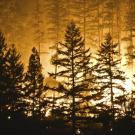
High-severity wildfires in northern coastal California have been increasing by about 10 percent per decade since 1984, according to a study from the University of California, Davis, that associates climate trends with wildfire.
Isaya Kisekka, associate professor in the Department of Land, Air and Water Resources and in the Department of Biological and Agricultural Engineering, is the recipient of the 2020 Excellence in Education Award from the Irrigation Association (IA). The award recognizes a person who teaches irrigation, water management and/or water conservation at a two- or four-year institution.
California may see a 54 percent increase in rainfall variability by the end of this century, according to new research from the lab of Assistant Professor Da Yang, a 2019 Packard Fellow and atmospheric scientist with the University of California, Davis.
Award Recognizes Exemplary Teaching, Research and Service
Professor Kyaw Tha Paw U carries a cheat sheet of sorts to class, with thumbnail photos and names of his students. Across a sea of faces, this personal class roster helps him learn each of their names, an effort he takes very seriously.
“He learned everyone’s names,” a student wrote on a class evaluation. “In doing so, I knew he could call on me at any time, which caused me to always pay attention. Amazing professor!”