High-quality agricultural index insurance has shown promise in promoting resilience among small-scale farmers who face a constant risk of drought and other weather-related shocks. However, despite decades of investments this tool has yet to achieve its broadest impact in part because of low-quality contracts that don’t reliably pay farmers for losses and that sometimes pay when there are none.
Faculty and students in the Department of Agricultural and Resource Economics study the production, distribution and consumption of food, fiber and energy in both well-developed countries and emerging economies. The depth, breadth and rigor of the department’s teaching, research and outreach enable them to make major contributions to society in the areas of agriculture, environment and natural resources, and international development.
Economists and nutritionists advise fortifying nation’s wheat supply
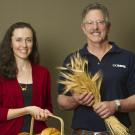
She aspires to provide nutritious food to every malnourished child; he wants to do so as efficiently as possible. Together, they and their UC Davis team and in-country collaborators have won global recognition for their proposals to help boost Haiti out of poverty.
Climate change will likely cause wheat and barley yields to decline by 17 to 33 percent by the end of the century, predicts a new statistical model developed by researchers at the University of California, Davis, and Cornell University.
Ozone pollution threatens rice crop; researchers see hope
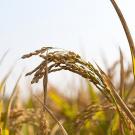
High levels of surface ozone are damaging rice yields at an alarming rate in China, the world’s largest agricultural producer and one of its most polluted nations, report researchers at the University of California, Davis, and in China.
For the first time, the research team identified a specific stage of the rice plant’s development as being vulnerable to ozone pollution, which they warn has the potential to impact the international rice market and compromise global food security.
Positive impact of direct marketing has ripple effects in regional economy
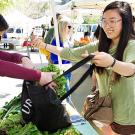
Sacramento-area farmers and ranchers who sell their products directly to consumers generate twice as much regional economic impact per dollar of output as do area food producers who don’t engage in direct marketing, reports a UC Davis agricultural economist and a team of UC Cooperative Extension researchers.
Refugees Can Offer Economic Boost to Their Host Countries
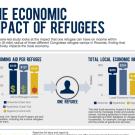
Refugees are often considered an economic burden for the countries that take them in, but a new study conducted by UC Davis with the United Nations World Food Program indicates that refugees receiving aid — especially in the form of cash — can give their host country’s economy a substantial boost.
The researchers found that these economic benefits significantly exceeded the amount of the donated aid.
Congratulations to the 1,615 undergraduate students who will cross the stage at one of two CA&ES commencement ceremonies on Friday, June 10, in the ARC Pavilion. We are anticipating the participation of numerous faculty and 60 volunteer staff in this year’s ceremonies.
Our distinguished speakers this year include alumni Richard and Evelyne Rominger, who for decades have played prominent roles in the community and in statewide and national agriculture. Richard and Evelyne Rominger also have been named recipients of the 2016 UC Davis Medal, the premier campus accolade.