Bees play a critical role in California’s agricultural ecosystems by pollinating many important crops, including almonds. Climate change, habitat loss, pesticides and other factors pose problems for bee populations.
To date, KIND Snacks has donated $350,000 for bee research at UC Davis, led by Entomology Professors Neal Williams and Elina Niño for continued research on bee health. California grows the vast majority of the world’s almonds, which rely on bees and other pollinators.
A new study from researchers at the University of California, Davis, finds that pesticides not only directly affect bee health, but effects from past exposure can carry over to future generations. The study, published in the journal Proceedings of the National Academy of Sciences, suggests that bees may require multiple generations to recover from even a single application.
Study Finds 57% Drop in Reproduction When Exposed to Both Threats
The loss of flowering plants and the widespread use of pesticides could be a double punch to wild bee populations. In a new study, researchers at the University of California, Davis, found that the combined threats reduced blue orchard bee reproduction by 57 percent and resulted in fewer female offspring. The study was published in the journal Proceedings of the Royal Society B.
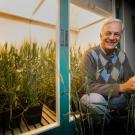
A team of scientists affiliated with the UC Davis Foods for Health Institute and entomology professor Bruce Hammock are among the recipients of the 2020 Chancellor’s Innovation Awards, which recognize faculty, project teams and community partners for their work, dedication and success in improving the lives of others and addressing the needs of society.
$3 Million Grant Awarded to Study Causes, Impact of Grapevine Virus
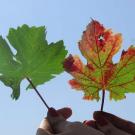
University of California, Davis, scientists will lead a collaborative effort to study grapevine red blotch disease, which threatens the $162 billion U.S. grape industry. The virus causes red veins and blotches on grape leaves. The fruit on diseased plants is smaller, ripens more slowly, and its sugars and colors are muted.
Sixteen UC Davis researchers have been named in the annual Highly Cited Researchers 2019 list released by the Web of Science Group, which compiles statistics on scientific publishing. The list identifies scientists and social scientists who have published multiple papers ranking in the top 1 percent by citations in a particular field and year, over a 10-year period.
Citation counts represent how often a particular paper has been cited in other scientific publications.
UC Davis researchers included in this year’s list are:
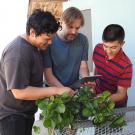
Strawberry growers now have a free smart phone application tool to predict spray coverage to combat such pests as two-spotted spider mites, lygus bugs and leafrollers, thanks to a three-year collaborative project involving UC Davis agricultural entomologist Christian Nansen and several UC Davis computer science majors.
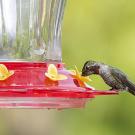
Many people set up hummingbird feeders in their yards to nurture and watch these high-energy pollinators. But could the sugar water they provide be impacting these tiny feathered friends?
A study led by the University of California, Davis, is one of the first to address the potential for sugar water from hummingbird feeders to act as a vector for avian — or even zoonotic — pathogens. It found that the majority of microbes growing in feeders do not likely pose a significant health hazard to birds or humans.
The Department of Entomology and Nematology is focused on addressing the broader scientific and societal importance of arthropods and nematodes. Departmental research is grouped into five broad areas: biodiversity, ecology, functional biology, sustainable agriculture and vector biology.
UC Davis entomology professor Frank Zalom receives national award
Frank Zalom, an integrated pest management (IPM) specialist and distinguished professor of entomology, is the recipient of the 2017 B.Y. Morrison Medal, established in 1968 by the U.S. Department of Agriculture/Agricultural Research Service (USDA-ARS). He is the first entomologist to receive the award.