Food & Agriculture

New Sensory Immersive Room at UC Davis Simulates Real-life Environments for Product Testing

What makes a cup of coffee or an energy bar enjoyable is usually more than just the taste. The surrounding environment may also influence the experience.

With that in mind, the Department of Food Science and Technology at University of California, Davis has constructed a new multi-sensory immersive room that can be used for product development, innovation and research.

Lynda and Stewart Resnick Pledge $50M to UC Davis for Sustainability Research

The University of California, Davis, today announced that philanthropists Lynda and Stewart Resnick, co-owners of The Wonderful Company, have pledged the largest gift ever to the university by individual donors. The $50 million pledge will support the school’s longstanding commitment to address today’s most pressing challenges in agriculture and environmental sustainability. 

Cabernet Can Survive Climate Change

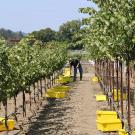
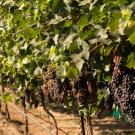
Exposing wine grapes to sunlight was the key to making a good quality cabernet. But even the toughest grapes may not withstand the extreme heat that comes with climate change. Too much heat, like California has experienced with recent heat waves, can lead to jarringly jam-like wines that are high in alcohol and sugar and lacking in acidity.

Vegetable Disease Field Day Tours Draw a Crowd

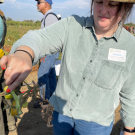
Scientists, growers, students and Cooperative Extension specialists gathered at UC Davis on Wednesday as part of Vegetable Disease Field Day, hosted by the Department of Plant Pathology.

Two sessions – one in Spanish, one in English – focused on tomato and crop rotation research being conducted in plant pathology fields on campus.

More than 70 people attended the English session, which included stops at three locations and was led by Cassandra Swett, an assistant Cooperative Extension specialist in plant pathology.


Agave: The New Drought-Tolerant California Crop?

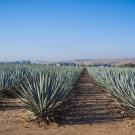
Agriculture in California faces an uncertain future as drought, wildfires and other climate extremes become more commonplace in the West. But a fledgling industry focused on growing and distilling agave plants, which are used to produce tequila and mezcal in Mexico, could be California’s answer to fallowed fields and a lack of water.

Growing Cereal Crops With Less Fertilizer

Researchers at the University of California, Davis, have found a way to reduce the amount of nitrogen fertilizers needed to grow cereal crops. The discovery could save farmers in the United States billions of dollars annually in fertilizer costs while also benefiting the environment.

The research comes out of the lab of Eduardo Blumwald, a distinguished professor of plant sciences, who has found a new pathway for cereals to capture the nitrogen they need to grow.

FFAR Grant to Help Improve Vineyard Soil Health

Wine grapes are susceptible to subtle changes in temperature and precipitation, making them particularly vulnerable to the effects of climate change. 

Regenerative agriculture, which uses holistic farming and grazing practices to strengthen soil health and crop productivity, may help grape vines become more resilient to changing climate conditions. However, more research is needed to increase adoption of regenerative agriculture practices on vineyards. 

The Cause and Effects of ‘Hop Creep’ During Beer Production

Crafting beer is a precise science. Brewers know that various types of yeast and different fermentation methods control how beer will taste. But a phenomenon known as “hop creep” can sometimes throw a brewer for a loop.

New research shows that perhaps brewers don’t have to feel bitter about it. A UC Davis study published in the Journal of the American Society of Brewing Chemists provides insight into why hop creep happens and its implications for brewers.

$4 Million Endowment Bolsters UC Davis Viticulture and Enology

The University of California, Davis, Department of Viticulture and Enology has received a $4 million endowment that will provide support in perpetuity for the kind of research and education that has made the department world renowned in its field.

The endowment, given anonymously, will fund unique projects that use and further develop analytical tools, advanced technologies and techniques, and equipment.